 ultimate-guide
Why Trades Businesses Need Automation
Table of Contents
- The Competitive Pressure Facing Trades Businesses Today
- How Automation Solves the Core Operational Bottlenecks
- Best Tools for Roofing Business Automation and Beyond
- Automating Lead Qualification for Contractors
- How to Simplify Trade Business Operations Without Disruption
- Measuring ROI and Scaling with Confidence
- Frequently Asked Questions
Last Updated: September 19, 2026
The Competitive Pressure Facing Trades Businesses Today
The trades industry is under unprecedented pressure. According to Jotform's 2026 business automation trends report, 88% of small and medium-sized businesses report that automation is now critical to competing effectively against larger corporations. Yet most trades businesses still operate with fragmented systems, manual scheduling, and missed calls that cost them real revenue.
Understanding why trades businesses need automation starts here: you're running a skilled operation. Your team knows how to install a roof, fix an HVAC system, or rewire a house. What they don't have time for is answering phones, qualifying leads, and managing invoices. That's where automation changes everything. At Global Velocity, we've seen trades businesses transform their operations by automating the front-desk work that steals hours from their day and dollars from their bottom line.
Why trades businesses need automation isn't a luxury question anymore, it's a survival question. The businesses that automate now are positioning themselves to capture market share. Those that don't risk falling behind as their competitors get faster, more responsive, and more professional.
How Automation Solves the Core Operational Bottlenecks
Automation doesn't replace your team, it removes the friction that prevents them from doing their best work. When you automate the repetitive, manual tasks that consume hours every week, your crew gets more time to focus on the actual work that generates revenue.
Reducing Manual Data Entry and Human Error
Manual data entry is one of the costliest hidden drains on a trades business. Every time a customer calls, someone has to write down their information, their job requirements, their preferred time window. That information gets entered into a CRM. A quote gets typed up separately. A follow-up reminder gets set manually. Each handoff is a chance for the information to get corrupted, duplicated, or lost.
According to 2am.tech's 2026 automation statistics, 58% of businesses adopt automation specifically to improve product quality, and that quality improvement starts with accurate data. When a customer's information flows automatically from the initial contact through to the job site, human error drops dramatically. No more misread phone numbers. No more jobs scheduled for the wrong address. No more invoices sent to the wrong email.
Automation captures data once, at the source, and syncs it everywhere it needs to go. Your CRM, your scheduling system, your payment processor, they all see the same information, in real time.
Improving Project Timelines and Resource Allocation
The second bottleneck is scheduling. Most trades businesses manage schedules the way they did ten years ago: a spreadsheet, a calendar, maybe a whiteboard. When a job runs over, when a customer cancels, when an emergency comes in, the entire day shifts. You're playing catch-up, calling crew members, rescheduling other jobs, and hoping nothing falls through the cracks.
Automation gives you real-time visibility into every job, every crew member, and every available slot. When a cancellation happens, the system automatically suggests the next available opening to the customer. When a job finishes early, the next crew knows immediately and can head to their next appointment. This isn't just about efficiency, it's about customer experience. Customers get faster service. Your crew spends less time idle or scrambling.
According to Kissflow's 2026 business process automation report, over 66% of organizations have now automated at least one business process, and scheduling is consistently the first process to go. The ROI is immediate: tighter schedules mean more jobs per crew per week, which directly increases revenue.
Simplifying Invoicing, Billing, and Payment Collection
Here's where automation hits your bottom line hardest. Invoicing and payment collection are cash-flow killers when done manually. A job finishes on Friday. The invoice gets written Monday. It goes out Tuesday. The customer sees it Wednesday and pays Friday, or later. You're waiting for money that should already be in your account.
Automation sends the invoice the moment the job is marked complete. Payment reminders go out automatically if payment doesn't arrive within your terms. Recurring customers get recurring invoices. You can even set up automated payment collection for customers who authorize it. The result: cash flows in faster, your accounting team spends hours less per week on follow-ups, and you have better visibility into what's actually owed to you.
Best Tools for Roofing Business Automation and Beyond
The market for automation tools has exploded, and most trades businesses end up with a patchwork of disconnected systems. One tool for scheduling. Another for payments. A third for CRM. A fourth for invoicing. Each one requires separate logins, separate data entry, and separate integrations.
Global Velocity takes a different approach. Rather than bolting together five different tools, we've built an all-in-one Business Operating System (BOS) designed specifically for trades. It handles calls, qualifies leads, schedules jobs, manages payments, and maintains your professional brand voice, all in one platform. Your AI employee answers calls in under two seconds, books jobs 24/7, and never misses a customer opportunity.
For roofing businesses specifically, this means no more missed calls from homeowners shopping for quotes. No more manual back-and-forth about availability. No more invoices getting lost in email. The system learns your business, your pricing, your availability, and your service area, then handles the front-desk work that typically consumes 10-15 hours per week.
Automating Lead Qualification for Contractors
One of the biggest wastes in contracting is time spent on unqualified leads. A customer calls asking about a job you don't do. Or they're calling from outside your service area. Or they're shopping for the absolute cheapest option and will never be a good customer. Your team spends 15 minutes on the phone figuring this out, and it was never going to convert.
Automation solves this by qualifying leads before they reach your team. The system asks the right questions: What's the job? Where is it located? What's the timeline? What's the budget range? Based on your criteria, it either books the job or politely explains that you're not the right fit.
This isn't about being cold or robotic. The system is trained on your specific business, your tone, your values. It sounds like your business because it is your business, just available 24/7. And it qualifies leads with 100% consistency, something no human receptionist can do after the eighth call of the day.
How to Simplify Trade Business Operations Without Disruption
The biggest fear trades business owners have about automation is disruption. "If we change our system, will we lose customers during the transition? Will our team resist? Will something break?"
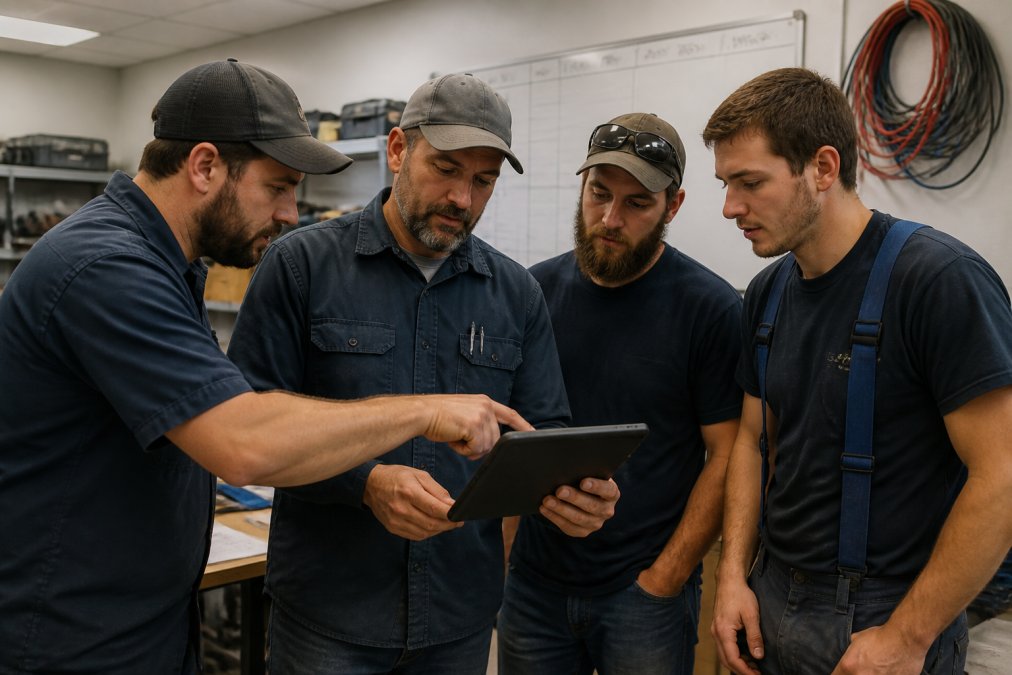
Those are legitimate concerns. But the data shows that when automation is implemented thoughtfully, the transition is smooth and the results are immediate.
Managing Change for Field Teams
Your field team didn't sign up to learn new software. They signed up to do their job. So the automation can't feel like it's making their job harder, it has to feel like it's making it easier.
The key is transparency and involvement. Before you implement, explain what's changing and why.
Mapping Your Integration Ecosystem
Before you implement automation, you need to know what systems you're already using and how they talk to each other. You probably have a CRM. Maybe a payment processor. A scheduling tool. An email system. An accounting package.
Security and Data Privacy in Automated Workflows
When you automate customer data handling, security becomes critical. You're storing customer information, payment details, job history. That data needs to be protected.
Measuring ROI and Scaling with Confidence
The real test of automation isn't whether it works in theory, it's whether it delivers measurable results.
For a trades business, automation typically delivers:
- Additional jobs per month (from fewer missed calls)
- Hours per week recovered (from eliminated manual tasks)
- Faster payment (from automated invoicing)
- Reduction in no-shows (from automated reminders)
| Operational Area | Manual Process Time | Automated Process Time | Weekly Time Saved |
|---|---|---|---|
| Call answering & scheduling | 8-12 hours | 1-2 hours | 6-11 hours |
| Lead qualification | 5-7 hours | 0.5-1 hour | 4-6.5 hours |
| Invoice creation & follow-up | 3-5 hours | 0.25-0.5 hour | 2.75-4.75 hours |
| Customer reminders & confirmations | 2-3 hours | Automated | 2-3 hours |
Frequently Asked Questions
Why is automation essential for small trades businesses?
Automation helps small trades businesses compete with larger corporations. 88% of small and medium-sized businesses report that automation is critical to staying competitive. For a solo operator or small team, automation handles repetitive tasks like call answering, lead qualification, and scheduling 24/7, freeing you to focus on actual billable work. This directly increases revenue per employee and reduces the cost of hiring additional office staff.
How does automating lead qualification for contractors improve booking rates?
Automated lead qualification systems ask the right questions in real time, ensuring only qualified prospects are booked. They capture job details, budget, timeline, and location instantly, reducing back-and-forth emails and missed opportunities. Contractors using workflow automation report faster project timelines and fewer scheduling conflicts. The system also sends automated reminders to customers, reducing no-shows and improving the overall customer experience.
What operational bottlenecks does automation solve for trades businesses?
The biggest bottlenecks are missed calls, manual data entry, and scattered scheduling. 67% of organizations now have 201 or more self-service automation users, showing how widespread adoption has become. Automation eliminates these pain points by answering calls instantly, capturing job details automatically, and syncing everything to your CRM and scheduling software. This reduces human error, improves project timelines, and lets you serve more customers without hiring more staff.
How much time can automation save my team each week?
Digital workflow automation can save employees up to 20 hours per week on repetitive tasks. For trades businesses, this means less time on phone calls, data entry, invoicing, and scheduling coordination. Nearly 60% of workers believe automation could significantly save them time on repetitive tasks. By consolidating multiple tools into one Business Operating System, you eliminate the context-switching and duplicate data entry that eats up hours every week.