 ultimate-guide
Best Practices for Emergency Service Dispatching
Last Updated: November 7, 2026
Quick Summary
The best practices for emergency service dispatching start with a fixed intake sequence: confirm location, callback number, nature of the emergency, and scene safety before anything else. Layer on priority-based triage, scripted decision support, protocol compliance, tested continuity plans, and performance tracking that reports the 90th percentile, not just averages.
- Confirm location first, then callback, nature, and safety, because a disconnected call with no address is nearly useless.
- Classify incidents into P1 to P4 priorities so over-triage does not tie up units another call needs.
- Dispatchers named as defendants in legal cases were significantly less likely to have used a standardized protocol.
- Schedule at least one manual-mode drill per year and rotate which shift participates.
- Track answer time at the 90th percentile, since averages hide the slowest calls.
Table of Contents
- Why Emergency Dispatching Standards Decide Outcomes
- Emergency Call-Taking Procedures That Hold Up Under Pressure
- Emergency Call Prioritization and Incident Classification
- Emergency Dispatch Scripts and Decision Support Tools
- Dispatcher Training, Certification, and Protocol Compliance
- Emergency Dispatch Software, Resilience, and Continuity Planning
- Measuring Dispatch Performance Without Guesswork
- Protecting Dispatchers From Burnout and Fatigue
- Frequently Asked Questions
Why Emergency Dispatching Standards Decide Outcomes
Emergency dispatching is the practice of receiving, triaging, and routing calls for police, fire, and medical help, and the standards behind it decide whether the right resource reaches the right address in time. The International Academies of Emergency Dispatch reports that more than 70,000 dispatchers have been trained worldwide on science-based protocols. At Global Velocity, we build AI phone systems for trades and service businesses, so we see the same principle play out on a smaller scale: structure beats improvisation. Below, we break down the best practices for emergency service dispatching, from intake sequence to performance measurement, so you can apply the discipline of a communications center to your own call handling.
Emergency Call-Taking Procedures That Hold Up Under Pressure
Emergency call-taking procedures are the fixed sequence a call taker follows to capture location, callback number, incident type, and scene safety before anything else. The sequence matters because callers under stress give information out of order, and a structured intake keeps the call taker from chasing details while the address goes unconfirmed.
The Intake Sequence: Location, Callback, Nature, Safety
The order is not arbitrary. Location first, because a disconnected call with no address is nearly useless. Callback second, so a dropped line can be recovered. Nature of the emergency third, to start triage. Safety last but never skipped, because responder safety depends on what the caller can see.
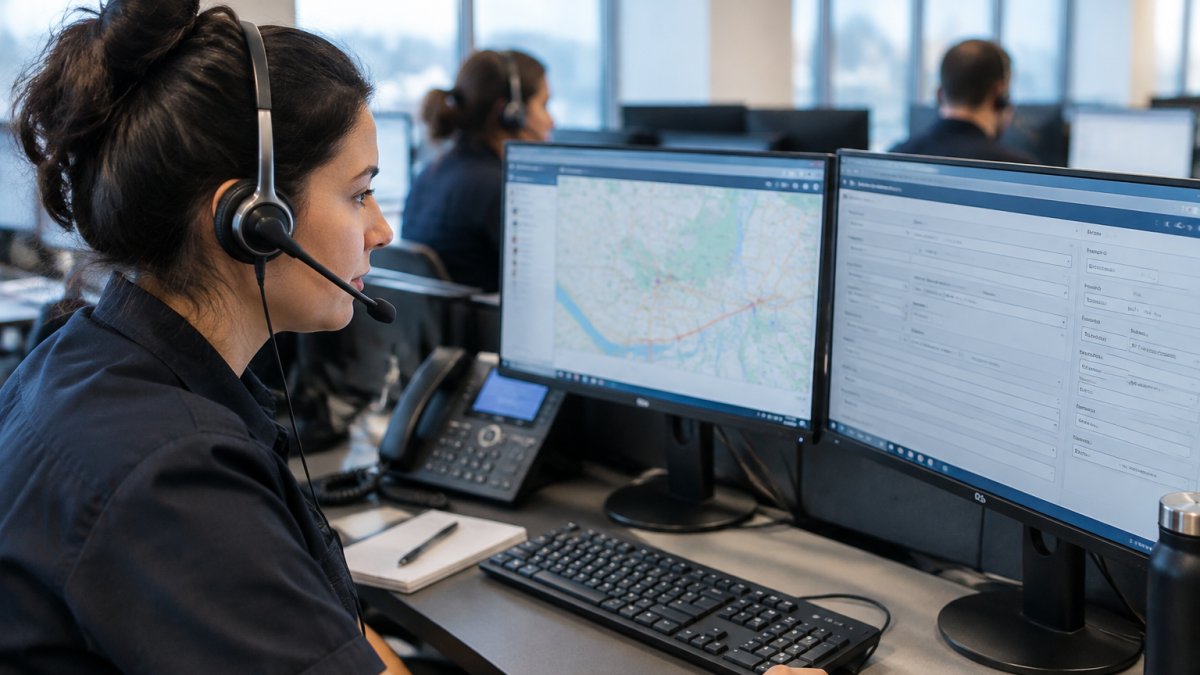
A common mistake is letting the caller's narrative set the order. In practice, a call taker who interrupts politely to confirm the address first saves minutes later. If you are comparing tools that can back up a live team, our guide to the best AI phone answering service for trades covers how automated intake handles overflow.
Emergency Call Prioritization and Incident Classification
Emergency call prioritization is the process of assigning a response priority to each incident based on threat to life, injury severity, and property risk. Incident classification turns the caller's description into a dispatchable code, and the two steps together determine resource allocation.
| Priority | Typical Incident | Response Expectation |
|---|---|---|
| P1 | Cardiac arrest, active fire, violent crime in progress | Immediate dispatch |
| P2 | Injury without immediate threat, smoke odor, property damage | Prompt response |
| P3 | Non-urgent reports, noise, minor damage | Scheduled response |
| P4 | Information requests, referrals | No dispatch, redirect |
Classification errors run both ways. Over-triage ties up units that another call needs; under-triage puts people at risk. A PMC review of dispatcher-assisted CPR research identified standardized training and protocol adherence as the key factors separating consistent outcomes from inconsistent ones.
Emergency Dispatch Scripts and Decision Support Tools
Emergency dispatch scripts are structured question sets that guide a call taker through triage and caller instructions without relying on memory. Decision support tools sit behind those scripts, surfacing the next question based on prior answers.
Scripts work because they remove variation. A dispatcher working from a script asks the same safety questions in the same order at 2 a.m. as at noon. The Minnesota Office of the Legislative Auditor documented administrative rules requiring a minimum 31-day retention period for 911 call records, which matters because scripts are only as good as the call review that follows them. If you are building structured call handling for a service business, our virtual receptionist buyer's guide walks through providers that follow defined protocols.
Dispatcher Training, Certification, and Protocol Compliance
Dispatcher training combines classroom instruction, simulation, and supervised live calls, and certification confirms the call taker can apply protocol under pressure. Protocol compliance is the part most centers underestimate: a certified dispatcher who abandons the script during a chaotic call is no safer than an untrained one.
Research published in the AEDR Journal found that dispatchers named as defendants in legal cases were significantly less likely to have used a standardized protocol during the call, even when one was available. That finding reframes compliance as a risk management issue, not just a quality one. Training should include recorded call review against the protocol, not just pass/fail simulation.
Emergency Dispatch Software, Resilience, and Continuity Planning
Emergency dispatch software handles call intake, location verification, unit recommendation, and radio or data handoff to responders. Resilience planning asks what happens when that software fails, and continuity planning asks who answers the phone in the meantime. Most centers treat these as IT concerns, but they are operational requirements: a dispatch center that cannot receive calls during a network outage is not dispatching at all.
The technology trend is toward real-time location verification and callback stability as core requirements, according to Convey911. Centers that treat these as nice-to-haves discover their value during an outage. The harder question is what happens when the primary system goes down entirely.
A practical continuity plan covers four failure modes:
- Power failure. Backup generators and uninterruptible power supplies must be tested under load, not just inspected. A generator that starts but cannot carry the dispatch workstations is not a backup.
- Network and communications outage. Redundant internet paths, diverse carriers, and analog fallback lines keep calls flowing when the primary circuit drops. The plan should name the specific fallback path and who activates it.
- Software or CAD failure. A documented manual dispatch procedure, paper tickets, radio-only coordination, and a pre-printed unit status board, lets dispatchers keep working while IT restores the system.
- Cybersecurity incident. Ransomware or a breach can take dispatch software offline for days. Isolation procedures, offline backups, and a communication tree to responders should be written down before an incident, not improvised during one.
Watch out: continuity plans that live only in an IT binder and are never exercised tend to fail at the moment they are needed, because dispatchers have never practiced the manual workflow under pressure. Schedule at least one manual-mode drill per year and rotate which shift participates.
For trades and service businesses, the equivalent question is what happens to after-hours calls when the office closes or the phone system goes down. Our AI built for trades and construction businesses covers how automated dispatch and lead capture keep work flowing when no one is at the desk.
Measuring Dispatch Performance Without Guesswork
Dispatch performance measurement tracks call-answer time, call-processing time, dispatch time, and response time as separate metrics, because averaging them together hides the real bottleneck. A center with fast answer times and slow processing times has a training problem, not a staffing problem. But time metrics alone do not tell you whether the dispatch was correct.
A working measurement program covers five categories:
- Answer time. How long a call rings before a call taker picks up. Track the 90th percentile, not just the average, because the slowest calls are the ones that matter.
- Call-processing time. How long the call taker spends on the line before dispatch. This is where protocol compliance and training show up.
- Dispatch time. The interval between call answer and unit notification. Separating this from processing time reveals whether delays sit with the call taker or the dispatch step.
- Accuracy. Whether the dispatched resource matched the incident as it actually was. Accuracy is harder to measure than time, but call review against the final incident report gives a workable sample.
- Protocol compliance. The percentage of calls where the call taker followed the scripted sequence. This is the leading indicator for both accuracy and legal defensibility.
Call volume data shows why staffing models need real numbers. RapidSOS analysis found 911 call volume peaks at 5:00 PM and hits its lowest point between 4:00 AM and 5:00 AM. Schedule to that curve and you stop overstaffing quiet hours. Targets should reflect local requirements and call mix, not a single national benchmark.
Watch out: a center that tracks only average answer time can hit its target while a small share of calls wait far too long, because averages hide the tail. Report the 90th percentile alongside the average so slow calls stay visible.
For the broader operational picture, our guide to managing service business operations shows how to fold dispatch metrics into your other KPIs.
Protecting Dispatchers From Burnout and Fatigue
Dispatcher burnout is the cumulative effect of repeated exposure to high-stress calls, and it shows up as slower processing, more protocol deviations, and higher turnover. Fatigue management is an operational issue, not a wellness perk, because a tired call taker makes classification errors.
Practical steps that hold up:
- Cap consecutive high-acuity calls before a rotation
- Build mandatory breaks into the schedule, not as a reward
- Debrief critical incidents within 24 hours
- Track protocol deviation rates as an early warning signal
Small teams face the same pressure. If your office staff absorb every after-hours call, an AI receptionist for plumbers can take overflow so your people are not answering calls at midnight.
The challenge is not knowing these practices; it is applying them consistently when volume spikes and staffing is thin. Global Velocity builds AI employees that answer calls in under two seconds, qualify leads, and book jobs around the clock, all inside one business operating system that replaces the stack of tools most teams juggle. Setup is managed for you, so you can stay on the tools instead of the phone. Get started with Global Velocity and stop losing work to missed calls.
Frequently Asked Questions
What information should a dispatcher collect during an emergency call?
Work through four blocks in order: verified location including building or unit number, a callback number in case the line drops, the nature of the incident and whether anyone is injured, and any scene hazards the caller can see. Confirm the address back to the caller rather than assuming it. Real-time location verification and call-back stability are now treated as core dispatch requirements, so treat a dropped call as a data gap to close, not a finished call.
How should emergency calls be prioritized?
Prioritization starts with incident classification: is there an immediate threat to life, is anyone trapped or injured, and is the scene safe for responders? Calls with active threats move ahead of property-only calls. Consistent classification matters because it supports defensible, repeatable call handling.
What should an emergency dispatch script include?
A useful script covers the intake sequence (location, callback, nature, safety), a short set of branching questions for the incident type, and pre-approved caller instructions such as staying on the line or moving to a safe exit. Keep the wording plain and short enough to read aloud under stress. Dispatcher-assisted CPR literature emphasizes standardized training and protocol adherence, so build scripts that support the protocol rather than replace it.
How can dispatch teams reduce errors and delays?
Three levers do most of the work: a fixed intake order so nothing gets skipped, call review against the protocol after the fact, and technology that fails gracefully. Pair that with continuity planning for outages and a quality assurance loop that reviews real calls, and errors surface before they become patterns.
How do dispatchers communicate clearly under pressure?
Use short sentences, confirm rather than assume, and read the address back to the caller. Ask one question at a time instead of stacking three. When giving caller instructions, keep them to a single action per sentence and check that the caller understood before moving on. This matters for accessibility too: plain language and language access support help callers who are panicked, hard of hearing, or not fluent in English follow instructions correctly.
What tools help emergency dispatchers coordinate responses?
Emergency dispatch software typically combines computer-aided dispatch, mapping with real-time location verification, and radio or digital communication with first responders. The practical test is resilience: what happens when the map fails, the call drops, or the system goes down. For trades and service businesses handling after-hours calls, the equivalent is a call handling system that captures the address, qualifies the job, and books it without a dispatcher at a desk.