
 ultimate-guide
HVAC Customer Data Privacy Best Practices for 2026
Last Updated: November 5, 2026
Quick Summary
Customer data privacy in 2026 starts with knowing what personal information you collect and why, then limiting collection to defined business purposes. Configure role-based CRM access with audit logging, vet AI and thermostat vendors in writing, and train staff quarterly on field-specific risks.
- Network segmentation can reduce data breach propagation risk by 50%.
- Set role-based permissions so dispatchers see schedules, not payment histories.
- Ask AI vendors five written questions covering storage, encryption, retention, sub-processor status, and deletion.
- Purge raw thermostat telemetry when a maintenance contract ends, keeping only the summarized service record.
- A shared dispatcher login defeats every access control you have configured.
Table of Contents
- Why HVAC Customer Data Privacy Is a 2026 Business Priority
- PIPEDA Compliance for Small Businesses: The HVAC Basics
- Secure CRM Practices for HVAC: Configuring for Privacy
- AI Lead Qualification Privacy Risks and How to Control Them
- Protecting IoT and Smart Thermostat Data
- A Customer Privacy Policy Template for Trades Businesses
- Training Your Team on Customer Data Privacy
- Building a Privacy-Ready Front Desk with Global Velocity
- Frequently Asked Questions
Why HVAC Customer Data Privacy Is a 2026 Business Priority
Customer data privacy is no longer a back-office concern for HVAC contractors.
The stakes are concrete. Network segmentation can reduce data breach propagation risk by 50%, according to Jett Business Technology's data security guidance.
This guide covers the best practices for HVAC customer data privacy in 2026: what the law requires, how to configure your systems, and where the real risks hide.
PIPEDA Compliance for Small Businesses: The HVAC Basics
PIPEDA compliance for small businesses starts with one principle: know what personal information you collect and why.
The Office of the Privacy Commissioner of Canada's 2025-2026 survey of businesses on privacy found a majority of surveyed businesses now maintain formal practices to protect customer personal information. Awareness is improving, but formal practice and real-world discipline are not the same thing.
The 10 Fair Information Principles in Plain Terms
The law rests on ten principles. For HVAC operators, these matter most:
- Accountability: One named person owns privacy. Not "the office."
- Identifying purposes: Tell customers why you need their address and equipment details before you collect them.
- Consent: Get clear agreement, especially before adding someone to a marketing list.
Data minimization is now a mainstream best practice, not an optional nicety. Fisher Phillips' 2026 guidance on data minimization frames it plainly: collect only the data necessary for a defined business purpose.
What Breach Notification Actually Requires
Watch out: assuming a small leak doesn't need reporting is a common compliance mistake. Breach notification obligations depend on whether there is a real risk of significant harm, and the assessment is yours to document. Keep an incident response plan written down before you need it, and check the Office of the Privacy Commissioner of Canada's breach reporting guidance for current requirements rather than relying on secondhand summaries.
Secure CRM Practices for HVAC: Configuring for Privacy
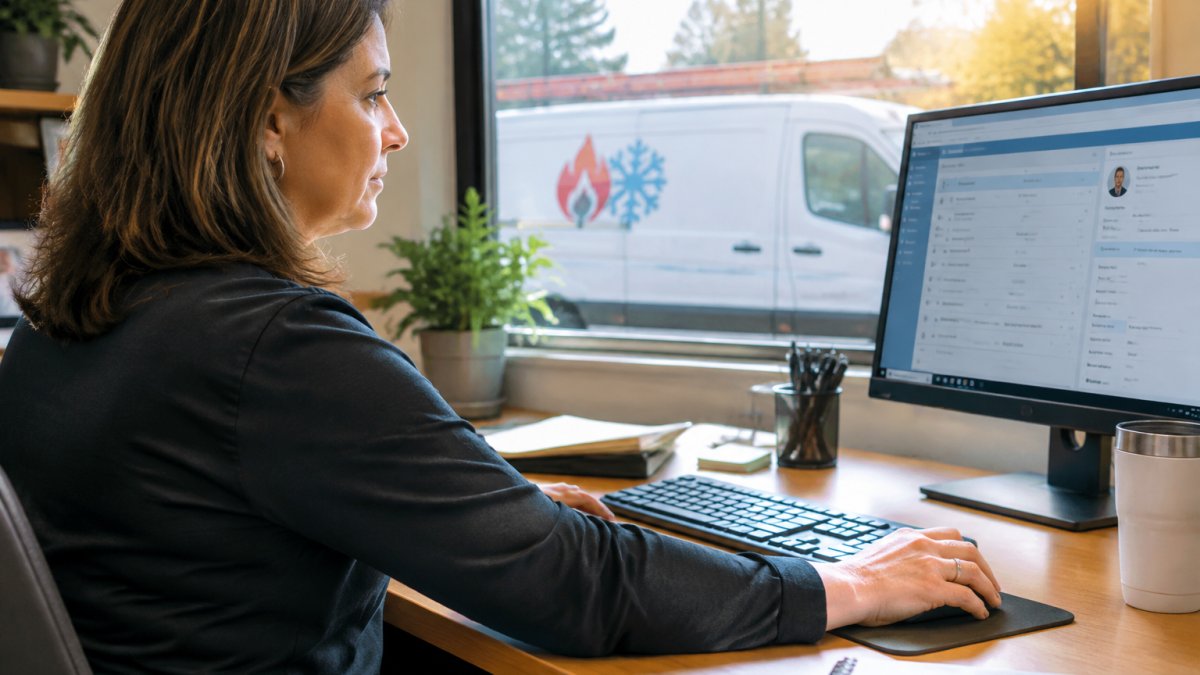
Secure CRM practices for HVAC begin with a simple rule: every user gets the narrowest access their job requires, and every record change is logged. Your CRM holds the crown jewels, so configuration decisions are privacy decisions.
Access Control and Audit Trails
Access control and audit trails turn a customer database into a defensible record. Set role-based permissions so dispatchers see schedules, not payment histories. Turn on audit logging for record views, edits, and exports, and review the logs quarterly, an audit trail nobody reads is decoration.
If you want assurance that the platform underneath you takes this seriously, you can review how Global Velocity protects business data with enterprise-grade encryption and SOC 2 compliance.
AI Lead Qualification Privacy Risks and How to Control Them
AI lead qualification privacy risks come down to one question: what happens to a caller's information after the AI finishes asking questions? Voice agents capture names, addresses, equipment details, and sometimes payment intent, each personally identifiable information that needs a defined lifecycle.
Before you evaluate any tool, read our guide on how AI lead qualification works for contractors so you understand the data flow you are approving.
Questions to Ask Before an AI Tool Touches Customer Data
Ask these five questions before signing anything:
- Where is the data stored, and does it leave the country? Cross-border transfer rules apply.
- Is data encrypted at rest and in transit?
- How long are call recordings and transcripts retained, and can we set our own retention window?
- Is the AI vendor a sub-processor we must disclose in our privacy policy?
- Can we export and delete customer records on request?
If a provider cannot answer all five in writing, that is your answer.
Protecting IoT and Smart Thermostat Data
Smart thermostat data is the privacy blind spot in most HVAC businesses. Remote monitoring and predictive maintenance data reveal when a home is empty, when occupants sleep, and how they heat and cool, sensitive behavioral information homeowners increasingly know about.
Why Thermostat Telemetry Is Different
A service address and a furnace model number are personal information. A year of hourly temperature setpoints, occupancy patterns inferred from motion sensors, and geofencing events is closer to a behavioral profile.
The practical problem is that HVAC companies often do not control the full data path. The thermostat manufacturer, the energy utility running a demand-response program, and your field service platform may each hold a copy.
A Practical Data Lifecycle for Connected Equipment
Treat thermostat telemetry as personal information with a defined lifecycle, not as an infinite technical log. A workable pattern looks like this:
- Collection: Collect only the telemetry needed for the service you sold. If you are not actively monitoring a system for a maintenance contract, do not pull hourly runtime data.
- Purpose disclosure: State in plain language what the connected device data is used for: diagnostics, warranty validation, predictive maintenance, or energy reporting. Do not bundle marketing consent into diagnostics consent.
- Access limitation: Restrict telemetry dashboards to the technicians and dispatchers who need them. A comfort advisor does not need a year of occupancy graphs to quote a replacement system.
Watch out: assuming the thermostat manufacturer's privacy policy covers your obligations is a common and costly mistake. If you are the one collecting the data through your platform, you are accountable for it under PIPEDA, even if a third party stores it.
Vendor Questions Specific to Connected HVAC Equipment
Before you enable remote monitoring on any platform, get written answers to these questions:
- Does the platform pull data directly from the thermostat, or does it rely on the manufacturer's cloud? The answer determines who your sub-processors are.
- Can you configure the telemetry sampling rate, or does the platform collect at full resolution by default?
- Where is the telemetry stored, and does it cross borders? Cross-border transfer rules apply to connected-device data just as they do to billing records.
- Can you set a retention window inside the platform, or must you export and delete manually?
- Does the platform expose telemetry to third-party analytics or energy-market participants without your knowledge?
If a provider cannot answer all five in writing, that is your answer.
What to Tell Homeowners
Homeowners are not asking for a legal brief. They want to know three things: what the thermostat is sending, who can see it, and how to make it stop. A short connected-device addendum to your privacy policy answering those three questions in plain language does more for trust than a page of statutory references. Review it annually, because device firmware and platform features change faster than privacy policies usually do.
A Customer Privacy Policy Template for Trades Businesses
A customer privacy policy template for trades should be short enough that a homeowner actually reads it. Here is a workable structure you can adapt:
[Business Name] Privacy Policy What we collect: Contact details, service address, equipment information, service history, payment information, and connected-device data where you have consented. Why we collect it: To schedule and perform service, process payment, maintain equipment records, and send service reminders you have agreed to receive. Who we share it with: Scheduling, payment, and communication providers acting on our behalf. [List named sub-processors.] How long we keep it: [X years] after your last service, then deletion. Your rights: Request access, correction, or deletion by contacting [privacy officer name and email]. Questions: Contact our privacy officer at [email].
Fill in the brackets, name a real person, and review it annually.
Training Your Team on Customer Data Privacy
Employee training is where privacy policies go to die. Technicians photograph equipment labels, office staff read addresses aloud, and nobody thinks twice. A field-specific framework is more useful than generic "train your staff" advice, because the privacy risks in an HVAC business happen in a basement, a van, and a phone call, not in a conference room.
A Four-Module Framework for Field and Office Staff
A workable training program covers four modules, each short enough to deliver in a 20-minute session. Run them quarterly, and give new hires the first module in week one.
Module 3: Spotting phishing and social engineering. HVAC companies are targets because they hold payment information and scheduling data.
Module 4: What to do when something goes wrong. A lost phone, a misdirected email, a text sent to the wrong homeowner.
Field-Specific Scenarios to Rehearse
Training sticks when staff practice the awkward moments. Rehearse these:
- A homeowner asks the technician to text a quote to a spouse's phone number not on file. Route the request through the office; do not save the number in a personal phone.
- A technician photographs an equipment label for a warranty claim, capturing a serial number and home address. Upload it to the job record and delete it from the camera roll.
- A caller asks the office to read back the full service history for a property the caller does not own. Verify identity before disclosing anything.
Watch out: a shared dispatcher login defeats every access control you have configured. If two people use the same credentials, your audit trail cannot tell you who viewed or changed a record, and your breach response plan loses its most important evidence.
Logging Completion and Refreshing Annually
Keep a simple training log: who completed which module, and when. Review the whole program annually against your privacy policy and platform configuration, a training module that teaches staff to use a feature you have since disabled is worse than no training.
The training program covers four short modules, each delivered in a 20-minute session and run quarterly.
| Module | Focus | Key instruction |
|---|---|---|
| Module 1 | What counts as personal information | Use real examples from your own workflow |
| Module 2 | Where information is allowed to live | Customer information belongs in the field service platform only |
| Module 3 | Spotting phishing and social engineering | Verify by calling back on a number you already have |
| Module 4 | What to do when something goes wrong | Report it to the privacy officer immediately |
Building a Privacy-Ready Front Desk with Global Velocity
A privacy-ready front desk is one where customer information enters a controlled system from the first call and never sits in a technician's text messages.
Global Velocity offers an all-in-one Business Operating System that consolidates scheduling, CRM, and payment tools into one place.
If your phone is your lifeline, you can see the AI receptionist built for HVAC companies in Saskatchewan, or compare plans and benefits to find the right fit.
Frequently Asked Questions
What are the PIPEDA requirements for HVAC contractors?
PIPEDA requires HVAC contractors to obtain meaningful consent before collecting personal information, limit collection to what a job actually needs, protect that data with reasonable safeguards, and allow customers to access and correct their records. You must also report breaches of security safeguards that create a real risk of significant harm to the Office of the Privacy Commissioner of Canada and to affected individuals. Appointing a designated privacy officer and writing a clear privacy policy are the two starting points.
How does AI automation impact customer data privacy in 2026?
AI tools that answer calls and qualify leads record conversations, transcribe them, and store caller details, which means customer data privacy obligations extend to every vendor in that chain. Under PIPEDA you remain accountable for personal information even when a third party processes it on your behalf. Before adopting any AI booking or lead qualification tool, confirm where the data is stored, how long it is retained, whether it crosses borders, and what the vendor's breach notification commitments are.
What security measures should HVAC companies implement for customer records?
Start with role-based access control so technicians see only the jobs they are dispatched to, and require two-factor authentication on every account that touches customer records. Encrypt data at rest and in transit, keep an audit trail of who viewed or changed a record, and set a data retention policy that purges old job files on a schedule. Network segmentation can limit how far a breach spreads, which matters if office systems and field devices share one network.
How do I handle customer consent for digital marketing in the trades?
Ask for consent at the point of booking, state plainly what you will send (reminders, seasonal tune-up offers, review requests), and record the answer in your CRM with a date. PIPEDA requires consent to be meaningful, so a pre-checked box buried in a service agreement is weak. Keep an easy opt-out on every message and honor it within your system immediately. If you send commercial electronic messages, Canada's anti-spam law adds its own consent and identification requirements on top of PIPEDA.
What are the penalties for data breaches under Canadian privacy laws?
PIPEDA itself does not set a fixed fine for every breach, but the Privacy Commissioner can take a matter to Federal Court, which can award damages to complainants and order an organization to change its practices. Knowingly violating certain obligations can carry serious consequences, and the reputational cost of a breach in a referral-driven trade is often larger than any penalty. The practical priority is a written incident response plan, because the Commissioner expects breach reports to be filed promptly once a real risk of significant harm is identified.
What should a customer privacy policy template for trades include?
A workable policy names the privacy officer and their contact details, lists exactly what data you collect (contact details, service address, equipment serial numbers, payment records, call recordings), states why you collect each item, and explains how long you keep it. Add a section on who you share data with, including any AI or CRM vendors, and describe how a customer requests access or correction. Publish it where customers can find it, and date every revision so your team knows which version is current.
Privacy in 2026 is a competitive advantage, not a compliance chore. The HVAC businesses that document their data flows, lock down their CRM, and train their teams will be the ones homeowners trust with a key to the house. Get started with Global Velocity and put every call, lead, and customer record into one secure system built for trades businesses.