 blog
Qualifying HVAC Leads: A Filtering Framework for Busy Contractors
Last Updated: October 26, 2026
Quick Summary
The best ways to qualify HVAC leads start with four filters: service fit, service area, urgency, and decision authority. Qualifying HVAC leads means scoring each inbound call against these traits and routing top scores straight to dispatch, mid scores to a callback, and low scores to nurture.
- Every inbound call should clear four checks: service fit, service area, urgency, and decision authority.
- Ask five short questions, including the address, the issue, timing, and who approves the estimate.
- Score leads with weighted points: service offered and inside area earn +3 each.
- A lead scoring 10 or 11 goes straight to dispatch; seven to nine gets a callback within the hour.
- Start with no more than six scoring traits to keep dispatcher friction low.
Table of Contents
- Why Lead Volume Is the Wrong Metric
- The Four Filters Every Inbound Call Should Pass
- HVAC Lead Qualification Questions That Actually Reveal Intent
- Building an HVAC Lead Qualification Script Your Team Will Use
- HVAC Lead Scoring Examples: From Gut Feel to a Repeatable Model
- Negative Lead Filtering: Who You Should Not Book
- AI Lead Qualification for HVAC: What It Handles and What It Shouldn't
- Put Qualification to Work With an AI Front Desk
- Frequently Asked Questions
Why Lead Volume Is the Wrong Metric
Most HVAC companies treat qualifying HVAC leads as a numbers game: more calls, more forms, more booked jobs. That math breaks down fast.
The real problem is fit, not volume. A caller who needs a furnace repair in your zone and can approve the work may be a better fit than a price-shopper. Qualifying HVAC leads is about filtering for readiness, not chasing raw counts.
The Four Filters Every Inbound Call Should Pass
Every inbound call should clear four checks before it earns a spot on the schedule: service fit, service area, urgency, and decision authority. Miss one and you're booking a job you can't do or tying up a technician on a tire-kicker.
Think of these as gates: a lead that fails one isn't thrown out, it's routed differently.
| Filter | Question It Answers | Fail Consequence |
|---|---|---|
| Service fit | Do we actually offer this? | Wasted dispatch, unhappy customer |
| Service area | Are they in our zone? | Travel cost, scheduling chaos |
| Urgency | How soon do they need it? | Low-priority lead buried in queue |
| Decision authority | Can they approve the work? | Endless follow-up, no close |
Filter 1: Service Fit
Service fit asks one thing: can your team actually perform the work? A caller asking for a commercial rooftop unit when you only service residential systems is not a lead, however eager they sound. Capture the request in plain language and match it against your offerings before anyone promises a visit.
Filter 2: Service Area
A great lead outside your service area is a bad lead. Confirm the address early, not after a technician is dispatched. A postal-code check at the top of the call can help confirm whether the address is in your service area.
Filter 3: Urgency and Decision Authority
Urgency tells you where the lead goes in the queue: a no-heat call in January outranks a "thinking about a tune-up" call every time. Decision authority tells you whether the caller can say yes. Ask directly: "Are you the one who'll approve the repair?" If not, loop in the decision-maker before you book.
HVAC Lead Qualification Questions That Actually Reveal Intent
The best HVAC lead qualification questions are short, specific, and hard to answer vaguely. Skip the open-ended "How can I help?" and ask things that force a real answer.
Here's a starter set:
- What's the address where the work is needed?
- What's the system doing, or not doing, right now?
- Is this a repair, a replacement, or routine maintenance?
None of these ask the caller to self-diagnose, you're gathering facts that map to your filters. For a deeper playbook on qualifying residential service leads without adding staff, see our guide on qualifying residential service leads.
Building an HVAC Lead Qualification Script Your Team Will Use
A good HVAC lead qualification script is a checklist disguised as a conversation, not a rigid recital. Your team will abandon anything that sounds like a call-center robot, so build in room to breathe.
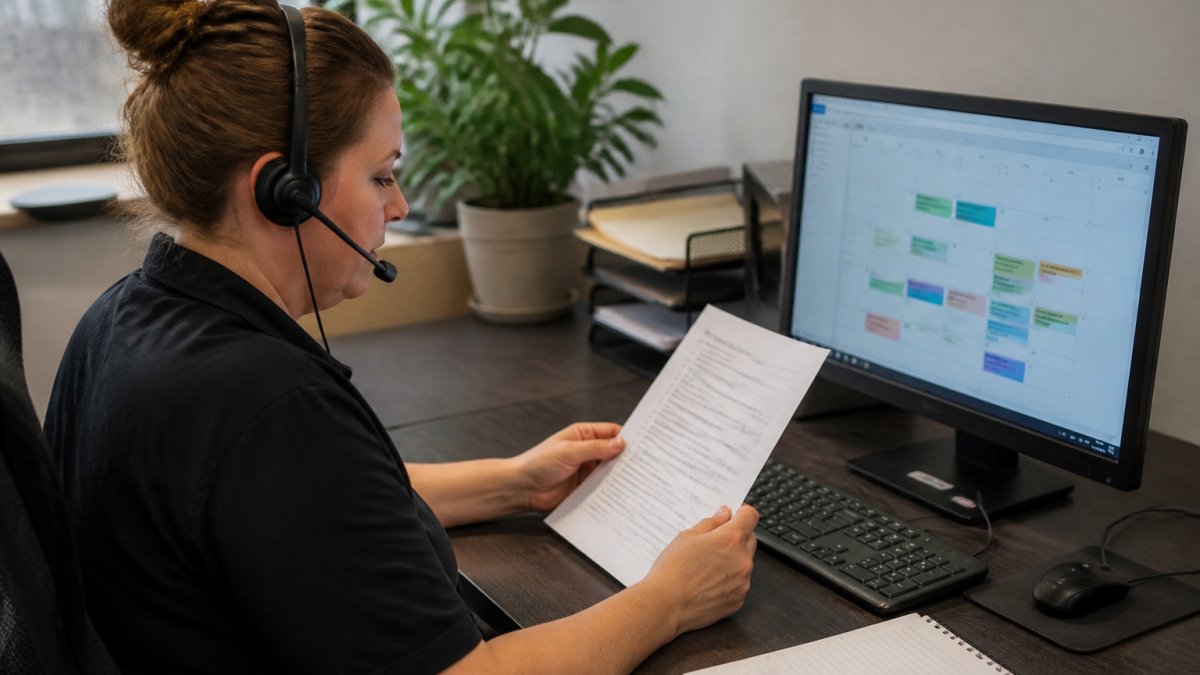
Structure it in three beats: open, qualify, confirm. Open with a warm greeting and the reason for the call. Qualify using the five questions above, in whatever order the conversation flows. Confirm by repeating back the address, the issue, and the appointment window.
Write the script on one page: a line for each filter, a note on what to do when a caller fails a gate, and a spot to log the outcome.
HVAC Lead Scoring Examples: From Gut Feel to a Repeatable Model
Lead scoring turns "this one feels good" into a number anyone on your team can reproduce: assign points for traits that predict a booked, profitable job, then rank leads by total. The real leverage is automating the score inside your CRM so every inbound lead, call, form, or chat, gets ranked before a human touches it.
A Simple Point-Based Scoring Model
Start with your four filters and weight them. Here's a working example you can adapt:
| Trait | Points |
|---|---|
| Service we offer | +3 |
| Inside service area | +3 |
| Needs service within 48 hours | +2 |
| Caller can approve the work | +2 |
| Replacement vs. repair inquiry | +1 |
A lead scoring 10 or 11 goes straight to dispatch. Seven to nine gets a callback within the hour. Below seven goes to nurture. You'll tune the weights over time.
Automating the Score in Your CRM
A manual score only works if someone remembers to calculate it.
For example, when a caller answers "Is this a repair or replacement?" the dispatcher selects from a dropdown and the CRM adds +1 for replacement, +0 for repair.
The result is a score that updates in real time: a lead that starts at 5 because the caller is unsure about timing can jump to 8 once they confirm service within 48 hours.
Dynamic Scoring and Decay
Static scores go stale: a lead that scored 9 on Monday but hasn't responded by Friday is no longer a 9. Some CRM systems may support score decay. Check your system's documentation for available options.
Engagement can be included in a scoring model. Whether a CRM can add points automatically depends on its features.
What to Do With the Score
The score is only useful if it changes behavior. Map score bands to actions:
- Top band (dispatch now): Route directly to the scheduling queue with a notification to the on-call technician.
- Middle band (callback within the hour): Assign to the office manager with a task and a deadline.
- Low band (nurture): Add to an email or SMS follow-up sequence.
Leads may move between bands as circumstances change, a homeowner who deferred a tune-up in spring may become a top-band lead when the furnace fails in October.
If you're weighing whether automation fits your filtering approach, our balanced look at automated lead qualification covers the trade-offs.
Negative Lead Filtering: Who You Should Not Book
Some leads cost more than they're worth, and saying no is a qualification skill. Negative lead filtering means spotting callers who will drain your schedule: out-of-area requests, services you don't offer, and prospects who can't or won't commit. A repeatable filter can use explicit disqualification criteria and a polite decline script.
The Four Disqualification Categories
Not every bad lead is bad in the same way. Group them so your team knows which response to use:
| Category | Example | Response |
|---|---|---|
| Out of service area | Caller 90 minutes outside your zone | Polite decline with a referral to a nearby contractor if you have one |
| Service you don't offer | Commercial rooftop unit when you only do residential | Decline and explain your scope; offer to refer if you know a commercial provider |
| No decision authority and no path to it | Renter whose landlord handles repairs and won't share contact | Ask for the landlord's contact; if refused, log as low-priority |
| Price-shopping with no urgency | Caller comparing quotes for a replacement "sometime next year" | Explain that the caller can follow up when ready |
Each category gets a different script. The goal is not to slam the door, it's to route the lead somewhere it won't waste a dispatch slot.
Scripts for Declining Without Burning the Relationship
The hardest part of negative filtering is saying no without sounding dismissive. A few possible patterns:
- Out of area: "I want to make sure you get someone who can be there quickly. We serve [your zone], and you're just outside it. I can point you to a contractor who covers your area, would that help?"
- Service you don't offer: "That's outside what our team handles, but I don't want to leave you stuck. Here's a company that specializes in that work."
- Price-shopper with no urgency: "It sounds like you're in the early stages. I can give you a ballpark range so you have a benchmark, and if you'd like, I can check in when you're closer to ready."
These scripts redirect the caller and leave the door open for future work. A caller who needs a commercial roofer today may need a residential furnace repair next year.
Protecting Technician Time With a Pre-Visit Checklist
Negative filtering doesn't stop at the phone. A lead that passes the call can still waste a truck roll if the technician arrives and finds the job isn't what was described. A pre-visit checklist sent by text or email before the appointment can help confirm details:
- Confirm the address and gate code or access instructions.
- Ask the homeowner to clear access to the unit (furnace closet, attic hatch, outdoor condenser).
- Confirm whether the homeowner will be present or has authorized someone else to approve work.
A lead that can't complete the checklist may need follow-up before the appointment.
When to Refer Instead of Decline
Referring a lead you can't serve is a qualification strategy, not a giveaway. A referral partner, a commercial HVAC contractor, electrician, or plumber, can send work back your way when they encounter a lead outside their scope.
Isn't turning away business bad? Not when the "business" is a two-hour drive for a job you'll lose money on. Filtering out unsuitable leads can help you focus on the requests that fit your business.
AI Lead Qualification for HVAC: What It Handles and What It Shouldn't
AI lead qualification for HVAC can be used for front-end tasks such as answering calls, asking qualification questions, checking an address against a service area, and booking appointments.
AI can be configured to ask the same questions consistently. Calls involving confusing descriptions or special handling may need to be routed to a person. For a fuller breakdown, read our guide to AI lead qualification for contractors.
Put Qualification to Work With an AI Front Desk
A caller who reaches voicemail may choose to contact another company, and the lead may be lost.
At Global Velocity, we build AI employees that answer calls in under two seconds, ask your qualification questions in a natural conversational tone trained on your business, and book jobs around the clock. Our AI receptionist for HVAC businesses can qualify leads and book service appointments 24/7. You can learn more about our services before you commit.
Watch out: if you hand qualification to any system without testing how it handles an out-of-area caller or a service you don't offer, you'll book jobs you can't complete. Test those edge cases first.
Frequently Asked Questions
What questions should an HVAC company ask when qualifying a lead?
Start with four: what system or issue the caller has, the property address to confirm it sits inside your service area, how soon they need someone, and whether they can approve the work. Add a question about the home's age or existing equipment when the job is a replacement. These four answers tell you whether to book now, book a diagnostic, or route the caller elsewhere. Keep the list focused on the information needed to qualify the lead.
How can HVAC companies prioritize high-intent leads?
Score each inbound lead on service fit, distance, urgency, and decision authority, then sort the queue by total points. A no-heat call in your service area from a homeowner who can approve work outranks a price-shopping caller asking about a tune-up in three months. Automated lead scoring can help sort leads by score.
How can AI help HVAC companies qualify leads and book appointments?
AI lead qualification for HVAC can answer calls within seconds, ask qualification questions, and book appointments 24/7. Set clear rules for what the AI can book on its own and what it should flag for a human, such as jobs outside your scope or anything involving a safety concern.
What information should an HVAC company collect before scheduling a service call?
Collect the caller's name, phone number, service address, the equipment type and symptom, how long the problem has been happening, and whether anyone will be home during the visit window. For replacements, note the system's age and any prior repairs. Confirm the caller can approve the work or note who can. Having this information before dispatch gives the team details about the request.
Your leads are only as good as the filter behind them. If you're ready to stop losing after-hours calls and start booking qualified jobs around the clock, get started with Global Velocity and put a tireless front desk to work for your business.