 listicle
AI Phone Answering for Contractors: 2026 Guide
Table of Contents
- Why Contractors Are Losing Revenue to Missed Calls
- How AI Phone Answering Works for Trade Businesses
- AI vs Live Answering Services for Contractors
- Automated Lead Qualification for Contractors
- Integrating AI with Contractor Scheduling Software
- Key Features That Deliver Real Results
- Getting Started with AI Phone Answering
- Frequently Asked Questions
Last Updated: September 2, 2026
Why Contractors Are Losing Revenue to Missed Calls
Missed calls are costing contractors thousands in lost revenue every month. According to Invoca's 2024 research, 27% of calls to home services businesses go unanswered, which translates to roughly $35 of lost ad spend for every $100 a shop invests when they're paying $129 per lead. That's not a minor inefficiency, that's a revenue leak you can see, measure, and fix.
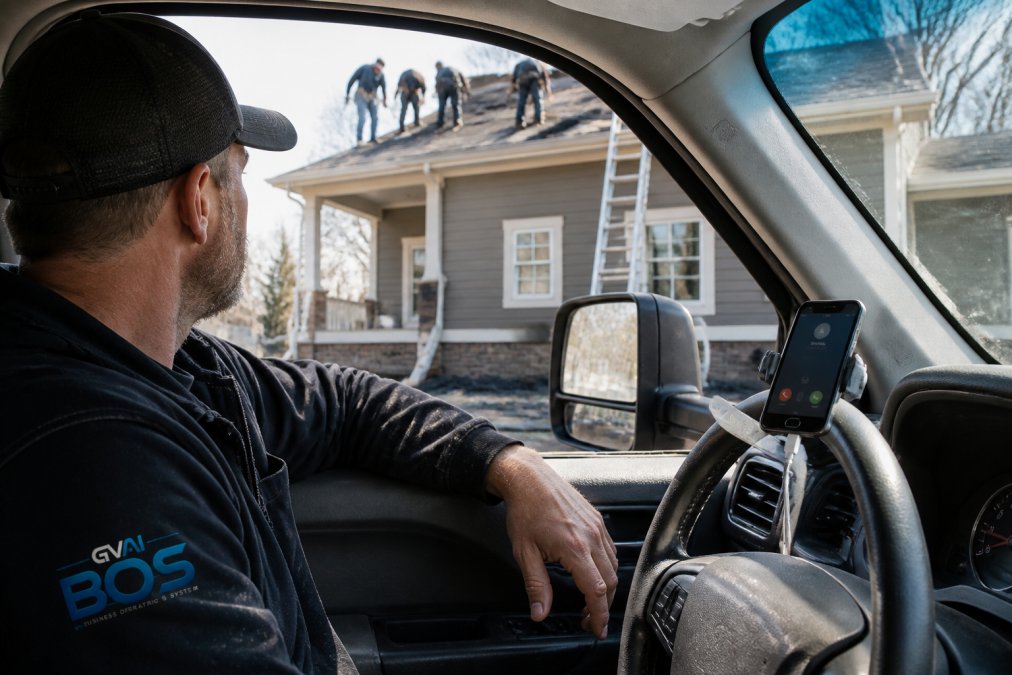
The problem compounds during peak seasons. When crews are on job sites, in attics, or underground, your phone sits silent. Potential customers call back competitors instead. By the time you return a call hours later, the lead is already booked elsewhere. This is why AI phone answering for contractors has become essential infrastructure, not a luxury. At Global Velocity, we've analyzed how hundreds of trade businesses lose opportunities, and the pattern is consistent: the businesses that capture every inbound call, regardless of time or circumstance, book significantly more work.
The math is straightforward. If you're spending money on marketing to drive calls, and you're not answering those calls, you're hemorrhaging ROI. AI phone answering solves this by ensuring every call gets answered instantly, qualified immediately, and either booked or logged for follow-up, all without a human receptionist tied to a desk.
How AI Phone Answering Works for Trade Businesses
AI phone answering for contractors uses voice technology trained on your specific services, pricing, and service area to answer calls in seconds and qualify leads automatically. When a customer calls, the AI greets them, listens to their request, asks relevant questions about the job, and either books an appointment directly into your calendar or logs the details for your team to follow up.
The process is straightforward. Your existing business phone number forwards to the AI system. The AI answers within two rings, speaks in a natural, conversational tone customized to your brand, and handles the intake conversation. For routine requests, scheduling, pricing questions, service area verification, the AI completes the transaction. For complex issues, emergencies, or situations requiring human judgment, the AI seamlessly transfers the call to your team or leaves a detailed transcript and next steps.
What makes this different from traditional call forwarding or voicemail is the qualification layer. Instead of a customer leaving a voicemail you'll return in three hours, the AI captures the job details, confirms your service area, and either books the appointment or schedules a callback. According to CallJolt's 2026 report, approximately 41% of home service businesses used some form of AI answering in 2025, up from 19% in 2023, signaling rapid adoption as voice quality improves and costs decline.
The integration happens through your existing CRM or scheduling software. Most AI phone answering systems connect to Google Calendar, Outlook, or purpose-built construction management platforms, pushing booked appointments and lead data directly into your workflow. This eliminates manual data entry and ensures nothing falls through the cracks.
AI vs Live Answering Services for Contractors
The comparison between AI and live answering services comes down to cost, availability, and consistency. Traditional live answering services employ human receptionists who follow a script specific to your business. They work during business hours or limited after-hours windows, charge per minute or per call, and apply the same script to every caller.
AI phone answering for contractors operates 24/7 without per-call fees, learns your business over time, and handles call volume spikes without additional cost. A live service scaling to handle 200 calls a week would require hiring additional staff. An AI system handles it in seconds.
Factor | Live Answering Service | AI Phone Answering |
|---|---|---|
Availability | Limited hours or 24/7 with premium pricing | 24/7 standard |
Cost Structure | Per-minute or per-call fees | Fixed monthly subscription |
Scalability | Requires hiring more staff for higher volume | Handles volume spikes instantly |
Customization | Generic script, limited flexibility | Trained on your business, adapts over time |
Data Integration | Manual data entry into your systems | Direct API connection to CRM/scheduling |
Consistency | Varies by receptionist quality and training | Consistent every call |
Emergency Handling | Follows protocol, may miss nuance | Recognizes urgency, escalates appropriately |
The cost advantage is significant. A full-time receptionist costs $35,000-$50,000 annually plus benefits. A live answering service for moderate call volume runs $200-$500 per month. AI phone answering for contractors typically costs less than a live service while operating 24/7 and integrating directly with your business systems.
Where live services still win is in handling highly emotional or complex conversations, an upset customer disputing a charge, or a negotiation requiring human judgment. The hybrid approach many contractors adopt is optimal: AI handles 80% of routine calls, and humans manage the 20% that require nuance or emotional intelligence.
Automated Lead Qualification for Contractors
Lead qualification is where AI phone answering for contractors delivers its biggest impact. Instead of logging every call as a lead and manually sorting them later, the AI qualifies in real-time by asking specific questions about the job.
A qualified lead for a roofing contractor looks different than for a plumber. The AI learns your business rules: service area boundaries, minimum job values, types of work you accept or decline. When a caller mentions a job outside your service area or requests a service you don't offer, the AI politely declines and suggests alternatives. This prevents wasted follow-ups and keeps your team focused on jobs you can actually win.
According to Statistics Canada's 2026 business conditions survey, 19.2% of businesses reported using AI to produce goods or deliver services, reflecting broader adoption across sectors. For contractors, the qualification piece is where ROI becomes visible. A roofing company receiving 40 calls per week might find that 15 are out of area, 8 are price shoppers, and 4 are for services they don't offer. That leaves 13 genuine leads. Without AI qualification, the team chases all 40. With AI, they focus on the 13 that matter.
The AI logs every call with transcripts, so your team can review conversations, understand what questions closed deals, and continuously improve the qualification criteria. Over time, the system learns which types of callers convert and which don't, refining its approach automatically.
Integrating AI with Contractor Scheduling Software
Integration is the bridge between answering calls and actually booking work. An AI phone answering system that doesn't connect to your scheduling software creates extra work: the AI books an appointment, your team manually enters it into their calendar, and duplicate bookings or conflicts emerge.
The best AI phone answering for contractors integrates directly with your existing tools. Whether you use Google Calendar, Outlook, ServiceTitan, Jobber, or another construction management platform, the AI should push appointments directly into your system. When a customer books a time slot, it appears in your crew's schedule immediately, and confirmation texts or emails go out automatically.
This integration also enables the AI to check real-time availability. If your team is fully booked for the next two weeks, the AI doesn't offer false appointment slots, it either schedules a callback for when capacity opens or adds the customer to a waitlist. This prevents the frustration of overbooking and maintains your reputation for reliability.
For contractors managing multiple crews or service areas, integration becomes critical. An HVAC company with teams in three different zones needs the AI to route appointments to the right crew based on location. A scheduling integration handles this automatically, preventing a crew in the north part of town from being assigned a job in the south.
Global Velocity's platform integrates with your existing CRM, payments, and scheduling through a Business Operating System that consolidates these tools into one workflow. This eliminates the data silos that plague contractors juggling multiple software subscriptions.
Key Features That Deliver Real Results
Not all AI phone answering for contractors is built the same. The features that separate systems that actually work from those that create frustration are specific and measurable.
Natural voice quality is foundational. According to research from Microsoft's 2025 SMB report, 71% of Canadian small and medium-sized businesses are now using AI or generative AI in their operations, with 70% reporting improved efficiency and productivity. However, voice quality matters, callers who hear robotic or unnatural speech immediately distrust the system. The best AI phone answering for contractors uses advanced natural language processing that sounds like a real person, not a text-to-speech engine.
Answering speed is another critical differentiator. If your AI takes 10 seconds to process a call and start speaking, callers hang up. The best systems answer within two seconds, creating the impression of a live receptionist picking up immediately.
Customization depth determines whether the AI sounds like your business or a generic service. Can the AI be trained on your specific services, pricing, service areas, and common customer questions? Does it learn from your actual call transcripts over time? Systems that allow deep customization perform better than those with fixed scripts.
Emergency detection is essential for contractors. If a caller is reporting a burst pipe, gas leak, or electrical fire, the AI must recognize the urgency and immediately transfer to a human or dispatch an emergency crew. Generic systems miss these cues.
Multi-language support matters in diverse markets. If your service area has significant French-speaking customers, the AI should handle calls in both English and French without forcing customers to choose.
Real-time transcription and logging ensures your team has a complete record of every call. This supports follow-up, dispute resolution, and continuous improvement of your qualification process.
Getting Started with AI Phone Answering
Implementing AI phone answering for contractors typically takes one to two weeks from decision to full activation. The process is straightforward, but getting it right requires attention to setup details.
Start by documenting your current call patterns. How many calls do you receive per week? What times receive the most volume? What are the five most common questions callers ask? What information do you absolutely need from every caller? This baseline helps you configure the AI appropriately and measure impact after implementation.
Next, define your business rules. What service areas do you cover? What's your minimum job value? What services do you offer or decline? Which calls should be automatically booked versus logged for callback? The more specific you are here, the better the AI performs.
Most providers handle the technical setup for you, forwarding your phone number to their system, configuring integrations with your scheduling software, and training the AI on your business details. You shouldn't need to manage DNS records or API keys; that's the provider's job.
Test the system with a small segment of your incoming calls before going live with 100% of calls. This lets you hear how the AI sounds, refine the qualification questions, and catch any integration issues before they affect customer experience.
Monitor call transcripts weekly during the first month. Listen to calls where the AI transferred to a human or failed to qualify a lead. Use these insights to refine the system. Did the AI miss a common question? Add it. Did it misunderstand a caller's request? Adjust the training.
After the first month, review your metrics: total calls answered, appointment booking rate, average call duration, and customer feedback. Compare these to your baseline. Most contractors see a reduction in missed calls and an increase in booked work within the first 30 days.
Contractors lose revenue to missed calls every single day. The businesses that fix this problem, by implementing AI phone answering that answers instantly, qualifies leads automatically, and integrates with their existing systems, reclaim thousands in lost opportunity. Global Velocity's AI employees answer calls in under two seconds, learn your specific business, and book jobs 24/7 without manual intervention. The result is a professional, always-on team member that never sleeps and never forgets a lead. Book a free demo to see how AI phone answering works for your business.
=== FAQ ANSWERS (audit these too, same rules) ===
[1] Q: How does AI phone answering improve lead conversion for contractors? A: AI phone answering captures every inbound call 24/7, even when crews are on job sites. A study by Invoca found that 27% of calls to home service businesses go unanswered, costing businesses roughly $35 of every $100 in ad spend. AI systems answer in under two seconds, qualify the caller, book appointments directly into your calendar, and send confirmation texts. This speed and consistency converts more callers into booked jobs.
[2] Q: Can AI phone answering services integrate with existing contractor CRM software? A: Yes. Modern AI phone answering platforms integrate with popular CRM tools, field service management software, and calendar systems. When a call comes in, the AI qualifies the lead, captures job details, and automatically logs the information into your existing CRM or scheduling tool. This eliminates manual data entry and keeps all customer information in one place. Integration setup typically takes a few days, and most providers handle the technical work so you can focus on running your business.
[3] Q: What are the primary benefits of using AI over a traditional answering service? A: AI phone answering runs 24/7 without per-call fees, answers instantly, and integrates directly with your scheduling and CRM systems. Traditional answering services employ humans on a limited script, work set hours, and require manual follow-up. AI captures structured data, qualifies leads in real time, and books jobs automatically. An independent survey of residential contractors found that those who have AI embedded in daily operations report measurable gains.
[4] Q: Are AI phone answering services compliant with Canadian privacy standards like PIPEDA? A: Reputable AI phone answering providers for Canadian businesses are PIPEDA-compliant and follow strict data security protocols. They encrypt customer information, limit access to authorized team members, and do not share data with third parties without consent. When evaluating a provider, confirm their privacy policy explicitly states PIPEDA compliance and ask about their data storage location and backup procedures. This is especially important for contractors handling client addresses, phone numbers, and service details.
Frequently Asked Questions
Q: How does AI phone answering improve lead conversion for contractors?
A: AI phone answering captures every inbound call 24/7, even when crews are on job sites. A study by Invoca found that 27% of calls to home service businesses go unanswered, costing businesses roughly $35 of every $100 in ad spend. AI systems answer in under two seconds, qualify the caller, book appointments directly into your calendar, and send confirmation texts. This speed and consistency converts more callers into booked jobs.
Q: Can AI phone answering services integrate with existing contractor CRM software?
A: Yes. Modern AI phone answering platforms integrate with popular CRM tools, field service management software, and calendar systems. When a call comes in, the AI qualifies the lead, captures job details, and automatically logs the information into your existing CRM or scheduling tool. This eliminates manual data entry and keeps all customer information in one place. Integration setup typically takes a few days, and most providers handle the technical work so you can focus on running your business.
Q: What are the primary benefits of using AI over a traditional answering service?
A: AI phone answering runs 24/7 without per-call fees, answers instantly, and integrates directly with your scheduling and CRM systems. Traditional answering services employ humans on a limited script, work set hours, and require manual follow-up. AI captures structured data, qualifies leads in real time, and books jobs automatically. An independent survey of residential contractors found that those who have AI embedded in daily operations report measurable gains.
Q: Are AI phone answering services compliant with Canadian privacy standards like PIPEDA?
A: Reputable AI phone answering providers for Canadian businesses are PIPEDA-compliant and follow strict data security protocols. They encrypt customer information, limit access to authorized team members, and do not share data with third parties without consent. When evaluating a provider, confirm their privacy policy explicitly states PIPEDA compliance and ask about their data storage location and backup procedures. This is especially important for contractors handling client addresses, phone numbers, and service details.